CAN, DBC, and the bit-ordering mess
This is the long-form answer to a narrow question: why does Logb define bit numbering the way it does? The short answer is in Specification §6.2. This document is the reasoning, because the rule looks arbitrary until you have seen what it is reacting to.
If you have ever written a CAN tool, you have scar tissue here.
The problem
A CAN frame is eight bytes with no structure of its own. What turns those bytes into `EngineSpeed` and `Odometer` is a database — usually a DBC file — that says, for each signal, where its bits are. So a signal is a bit slice: a start position, a width, and a byte order.
That last part is the trouble. A single CAN frame routinely mixes byte orders. The ECM team ships a message with little-endian ("Intel") signals; the ABS team ships one with big-endian ("Motorola") signals; sometimes one message has both, because two people wrote it. This is not pathological, it is Tuesday. Any format that cannot express both, per signal, is unusable for bus data.
Both conventions have to coexist, and describing them in one numbering scheme is where every format so far has come to grief.
What went wrong: the Motorola sawtooth
DBC numbers bits flat, LSB-first: bit 0 is the least significant bit of byte 0, bit 7 is the most significant bit of byte 0, bit 8 is the LSB of byte 1, and so on. One numbering for the whole frame.
Little-endian signals are contiguous in that numbering. A 12-bit Intel signal at bit 4 occupies bits 4 through 15. Nothing to explain.
Big-endian signals are where it falls apart. A DBC `start_bit` for a Motorola signal names the signal's most significant bit, and the rest of the signal is found by walking: descend through the byte, and on leaving the bottom of a byte, jump to the top of the next one. Vector's reference algorithm is literally this:
bit := start
for i := 0; i < length; i++ {
	v = v<<1 | uint64(d[bit/8]>>(bit%8))&1
	if bit%8 == 0 {
		bit += 15 // leave the byte: jump to bit 7 of the next
	} else {
		bit-- // descend
	}
}
Plot the bit numbers that walk visits and you get the thing the CAN world named the Motorola sawtooth:
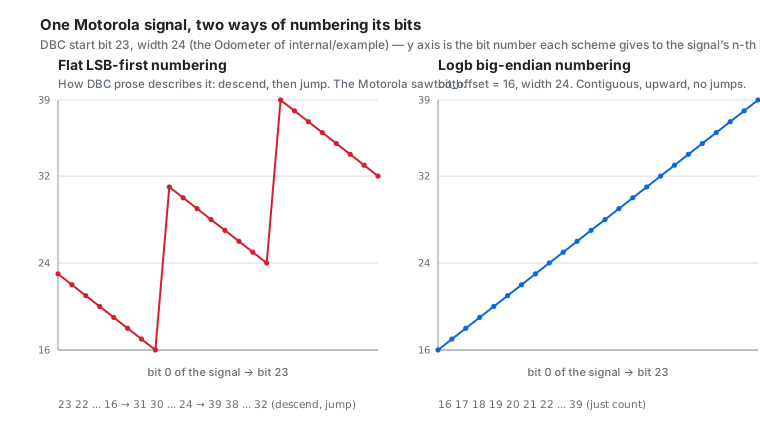
Both panels describe the same 24 physical bits of the same frame — the Odometer signal of `internal/example`, DBC start bit 23. Left is that signal's bits in flat LSB-first numbering: 23, 22, … 16, then a jump up to 31, down to 24, up to 39, down to 32. Right is the same signal in Logb's big-endian numbering: 16, 17, 18, … 39. Contiguous, upward, no jumps.
Nothing moved. No bytes were swapped, no data was transformed. The only difference is which numbering you describe the bits in.
The sawtooth is not a property of Motorola signals. It is an artefact of describing big-endian fields in little-endian numbering. It is what you get for insisting on one flat numbering and then bolting on a rule for how the other byte order walks through it.
The cost of that artefact
The sawtooth is not merely ugly. It has produced real, lasting damage:
- Formats disagree. DBC and MDF4 do not use the same bit numbering, so every
importer is a conversion, and every conversion is a place to be wrong.
- Unaligned big-endian is undefined. A Motorola signal that is not
byte-aligned and crosses a byte boundary has no defined meaning in MDF4. It is not that the answer is hard — there is no answer to look up. Every tool guesses, and the guesses do not agree.
- The prose is always wrong. This is the deep one. Every English statement of
bit numbering ever written has been ambiguous, wrong, or both — including two earlier drafts of this repository's own spec. MDF4 and DBC do not disagree because anyone was careless. They disagree because this is genuinely, structurally hard to say in words.
A wrong bit rule does not crash. It returns plausible-looking garbage: a speed that is almost right, an odometer that drifts. That is the failure mode worth designing against.
What Logb does
Bit numbering follows the byte order. That is the entire rule, and it has no exceptions:
- `byte_order = little` — bit n is byte n/8, bit n%8 counting from the
least significant bit of that byte.
- `byte_order = big` — bit n is byte n/8, bit n%8 counting from the
most significant bit of that byte.
In both cases `bit_offset` names the field's first bit, and the field is `bit_width` bits running upward from it. No alignment requirement, no jump, no special case for crossing a byte boundary.
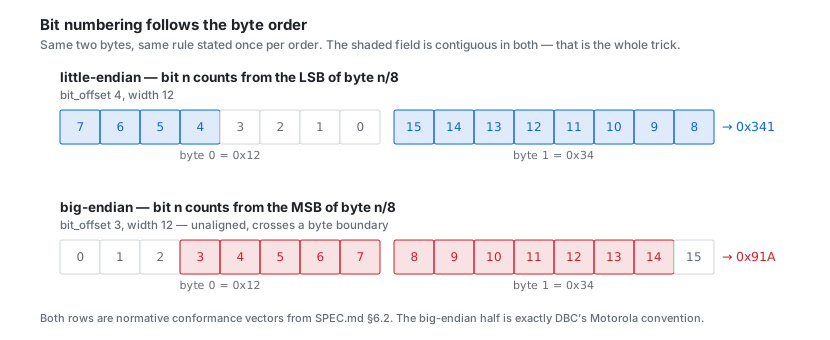
Why it works: each byte order's fields are contiguous in that order's own numbering. Little-endian signals run contiguously from the LSB; big-endian signals run contiguously from the MSB. That is a fact about the two conventions, not a trick. Number each in its own terms and the sawtooth simply does not exist — there is nothing to state, because there is no walk.
The conventional approach states one numbering plus a walking rule, and spends the rest of its life apologising. Logb states two numberings and no walking rule.
The DBC importer is one line
The big-endian half of the rule is DBC's Motorola convention. Not a near-relative of it — the same thing, said in numbering that suits it. So importing a Motorola signal is an offset transform:
func dbcStartToOffset(start int) uint32 { return uint32(8*(start/8) + (7 - start%8)) }
That is the whole cost. No data moves, nothing is lost, and every Motorola signal — aligned or not, byte-crossing or not — is a Logb field.
This claim is load-bearing, so it is tested rather than asserted. `TestDBCMotorola` transcribes Vector's reference walk independently of this package's `extractBits` and checks that two unrelated formulations agree across every combination of signal position, width, and payload:
$ go test -run TestDBCMotorola -v
    logb_test.go:889: agreed with the DBC reference algorithm on 465600 cases
--- PASS: TestDBCMotorola (0.03s)
If that test ever fails, the format has silently forked from every CAN tool in existence.
Why not just mandate one byte order?
It is the obvious simplification, and it was considered and rejected. The tempting argument is that a single order pushes the work out to importers, where it belongs.
It does not. It makes the data inexpressible.
Take every Motorola signal up to 32 bits wide that fits in an 8-byte CAN frame — there are 1,552 of them. Ask how many have any little-endian bit-slice that reads the same bits in the same order:
| Motorola signals (≤32 bits, 8-byte frame) | 1,552 |
|---|---|
| …with a little-endian equivalent | 288 |
| …of those, wider than one byte | 0 |
Only 288 are expressible at all, and not one of them is wider than a single byte. A plain byte-aligned 16-bit Motorola signal — utterly ordinary, in thousands of real DBC files — has no little-endian expression. Both orders read the same two bytes and disagree about which one carries the high half. No choice of offset and width fixes that, because it is not a numbering disagreement.
Byte order is not a convention layered over the bit model. It is a second thing, and a format for bus data has to carry both.
The vectors are the specification
Since every prose statement of this rule has historically been wrong, the specification §6.2 does not ask you to trust its prose. It publishes normative conformance vectors, and says plainly that the vectors, not the prose, are the specification:
| Record bytes | `byte_order` | `bit_offset` | `bit_width` | Raw value |
|---|---|---|---|---|
| `12 34` | little | 0 | 16 | `0x3412` |
| `12 34` | big | 0 | 16 | `0x1234` |
| `12 34` | little | 4 | 12 | `0x341` |
| `12 34` | big | 3 | 12 | `0x91A` |
| `78 56 34 12` | little | 0 | 32 | `0x12345678` |
| `12 34 56 78` | big | 0 | 32 | `0x12345678` |
The fourth row is the one that matters: big-endian, unaligned, crossing a byte boundary — the case MDF4 leaves undefined. It has exactly one right answer here, and `TestConformanceVectors` is that table. An implementation that reproduces it has the rule right; one that does not, does not. No implementer should ever have to recover this rule from prose, which is how the disagreement started.
The full table is in Specification §6.2.
What it looks like in practice
Byte order is per field, never per file or per frame:
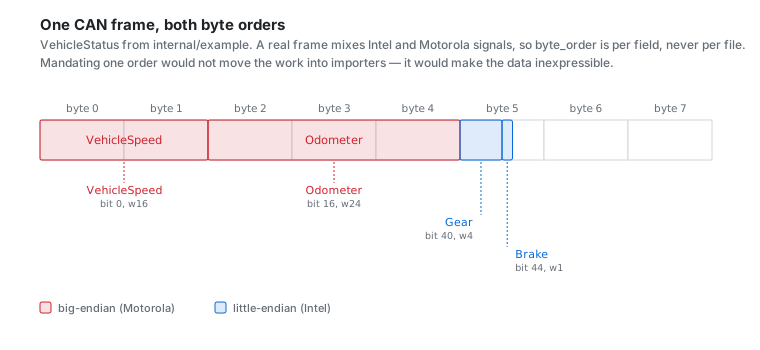
This is `VehicleStatus` from `internal/example`, a real schema in the golden test file. Motorola and Intel signals sit in one 8-byte frame; `Odometer` is unaligned and crosses byte boundaries. In Logb it is a field, declared like any other:
Fields: []logb.Field{
	{Name: "VehicleSpeed", BitOffset: 0, BitWidth: 16, Type: logb.TypeUint,
		BigEndian: true, Unit: "km/h", Conv: logb.Linear{A: 0, B: 0.01},
		Desc: "Motorola, byte-aligned (DBC start bit 7)"},
	{Name: "Odometer", BitOffset: 16, BitWidth: 24, Type: logb.TypeUint,
		BigEndian: true, Unit: "km", Conv: logb.Linear{A: 0, B: 0.1},
		Desc: "Motorola, crosses byte boundaries (DBC start bit 23)"},
	{Name: "Gear", BitOffset: 40, BitWidth: 4, Type: logb.TypeUint,
		Conv: logb.ValueToText{ /* P 1 2 3 4 5 6 R N */ }},
	{Name: "Brake", BitOffset: 44, BitWidth: 1, Type: logb.TypeBool},
}
Those `BitOffset` values are what the one-line importer computes from the DBC: `VehicleSpeed`'s start bit 7 becomes 0, `Odometer`'s start bit 23 becomes 16.
Two further things fall out, both of which matter more than they look:
- The raw payload is still there. `can0.raw` in the same file stores the eight
wire bytes verbatim in a fixed `bytes` field, which is what a logger with no database actually records. Signals overlay those same bytes; fields may overlap freely. Rule 5 — raw is preserved — means a read-modify-write round trip is byte-identical.
- The bit layout ships with the data. A DBC file is a sidecar that must still
exist, and still match, when someone opens the recording in 2050. In Logb the schema is restated in every segment, so a tool with no DBC can still name, scale, and unit every signal. The example carries its DBC as an attachment — as an artefact, never as something a reader must parse.
Multiplexed messages
Bit numbering says where a signal's bits are. A multiplexed message adds a second question: whether they are that signal at all. In a multiplexed DBC message one signal, the multiplexor (`M`), selects what the rest of the frame carries, and each multiplexed signal (`m4`, `m12`, …) exists only in frames whose multiplexor holds its value. The OBD2 response is the textbook case:
BO_ 2024 OBD2_Response: 8 ECU
 SG_ PID M : 16|8@1+ (1,0) [0|255] ""
 SG_ EngineLoad m4 : 24|8@1+ (0.39215686,0) [0|100] "%"
 SG_ CoolantTemp m5 : 24|8@1+ (1,-40) [-40|215] "degC"
 SG_ EngineSpeed m12 : 31|16@0+ (0.25,0) [0|16383.75] "rpm"
 SG_ VehicleSpeed m13 : 24|8@1+ (1,0) [0|255] "km/h"
All four signals sit on the same bits. A reader given only their positions decodes every one of them from every frame and returns a coolant temperature from a frame that carried a vehicle speed — plausible garbage again, one level up from the sawtooth.
What Logb does: guarded fields
Logb has no CAN-specific multiplexing construct. It has guarded fields (Specification §6.2): a field flagged as guarded is present in a record only when another field of the same record, its `guard_field`, holds the raw value `guard_value`. A multiplexed message maps onto that directly, as one stream per message:
- the multiplexor is an ordinary field, declared before anything that guards on it;
- each multiplexed signal is a field guarded on the multiplexor, with `guard_value` set to its `mN` value, overlapping the other variants freely.
For the message above, with the 64-bit timestamp at record bits 0–63:
| Field | `bit_offset` | `bit_width` | Byte order | Guard |
|---|---|---|---|---|
| `PID` | 80 | 8 | little | — |
| `EngineLoad` | 88 | 8 | little | `PID == 4` |
| `CoolantTemp` | 88 | 8 | little | `PID == 5` |
| `EngineSpeed` | 88 | 16 | big | `PID == 12` |
| `VehicleSpeed` | 88 | 8 | little | `PID == 13` |
`EngineSpeed` is Motorola start bit 31, and the one-line importer above puts it at payload bit 24 like any other big-endian signal: multiplexing and bit numbering are independent, and neither needs to know about the other.
Three rules make this safe rather than merely expressible:
- Absent is not zero. A reader that meets an unsatisfied guard MUST report the field absent and MUST NOT return a value for it. In a frame with `PID = 12`, `EngineSpeed` has a value and the other variants have none — not zero, and not the bits that happen to sit there. A plot shows a gap, a table an empty cell.
- The comparison is on raw bits. The guard compares the multiplexor's raw integer, before any conversion, so it is exact. Comparing physical values would mean float equality against the output of a linear conversion.
- It costs nothing per record. The guard lives in the schema, and the multiplexor is a value the frame already carried. Every guard is checked when the SCHEMA frame is read, so a bad one rejects the schema before any data is decoded.
The raw payload is still stored verbatim beside the decoded stream, so a reader that disagrees with the database can always go back to the wire bytes.
What is supported, and what is refused
Guards do not chain: a guard field must not itself be guarded (Specification §6.2). That is one level of selection, which covers ordinary DBC multiplexing and nothing beyond it.
| DBC construct | Logb |
|---|---|
| One multiplexor (`M`) with signals selected by a single value (`mN`) | Supported — the multiplexor is a field, each `mN` signal a guarded field |
| `SG_MUL_VAL_` naming one multiplexor and a single value (`N-N`) | Supported — the same as `mN`, written differently |
| Unmultiplexed signals in a multiplexed message | Supported — ordinary fields, present in every frame |
| `SG_MUL_VAL_` with a value range or several ranges | Refused for that signal — a guard holds one value |
| A multiplexor that is itself multiplexed (`mNM`), or two multiplexors in one message | Refused for the whole message — that is two levels of selection |
| A signal marked `mN` in a message with no multiplexor | Refused for that signal — there is nothing to guard on |
Refusing is deliberate. The alternative, decoding such a signal unguarded or guarded on the wrong selector, would put values in frames that do not carry them. A schema that is wrong about which bits are live is worse than no schema, because it still produces numbers. A refused message keeps its raw frames, so nothing is lost: it is only not decoded.
Lifting the one-level limit is the first item of the specification's future-work section (§13), which proposes letting a guard field itself be guarded, with a cycle check at schema validation. The same change would let a single raw CAN stream carry every message's signals guarded on the CAN id, with multiplexed signals guarded on their multiplexor below it. Until then, nested multiplexing is outside the format.
Summary
| DBC / MDF4 | Logb | |
|---|---|---|
| Bit numbering | one flat scheme, plus a walking rule | one per byte order |
| Big-endian signals | sawtooth: descend, jump, descend | contiguous, upward |
| Unaligned big-endian crossing a byte | undefined in MDF4; tools guess | defined, vectored, tested |
| Mixed orders in one frame | per-format problem | per-field, by construction |
| Importing a Motorola signal | a conversion to get wrong | `8*(start/8) + (7 - start%8)` |
| The normative statement | prose | conformance vectors |
| Where the layout lives | a sidecar that must survive | in the file, per segment |
| A multiplexed signal in a frame that does not select it | decoded anyway by tools that ignore the multiplexor | absent, by a guard on the multiplexor's raw value |
| Nested or ranged multiplexing | `mNM`, `SG_MUL_VAL_` | refused; guards do not chain |
See also
- Specification §6.2 — Field, bit numbering, guarded fields, and the full vector table
- Specification §6.3 — data types, and why `byte_order` is per field
- `logb_test.go` — `TestDBCMotorola`, `TestConformanceVectors`
- `internal/example` — the mixed frame above
- GNSS, time and the two clocks — the same raw-preserved, signals-overlaid argument for GNSS